KIWI – KI-unterstützte Wirkungsmessung für Inklusionsunternehmen
Project Description
KIWI addresses the growing demand for transparent, scalable, and accessible impact measurement in inclusion-oriented enterprises. While such organizations generate substantial social value, they often lack practical tools to systematically capture, analyze, and communicate their impact. KIWI combines human-centered design, modular data collection, and AI-supported analysis to enable standardized yet adaptable impact measurement across diverse organizational contexts.
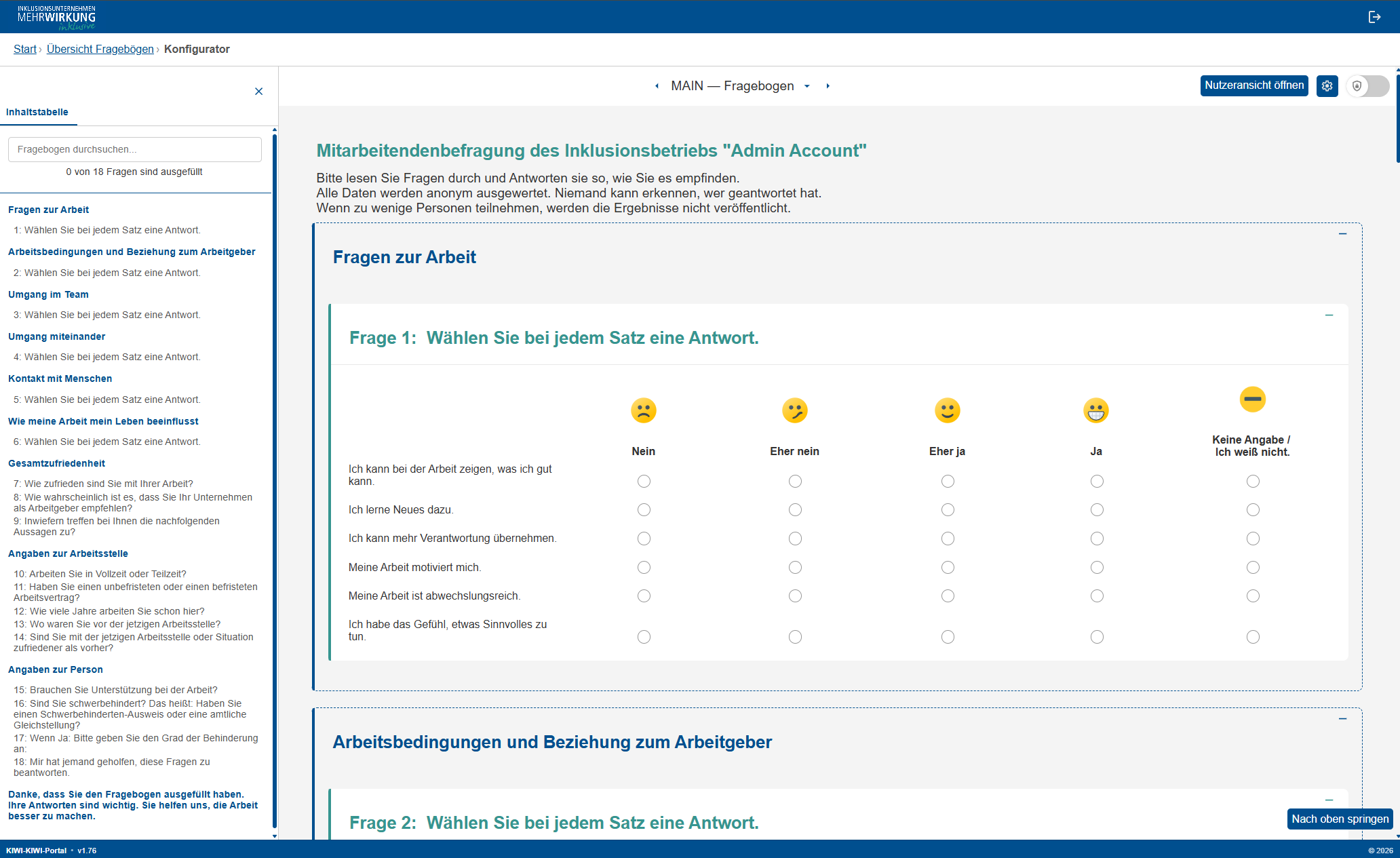
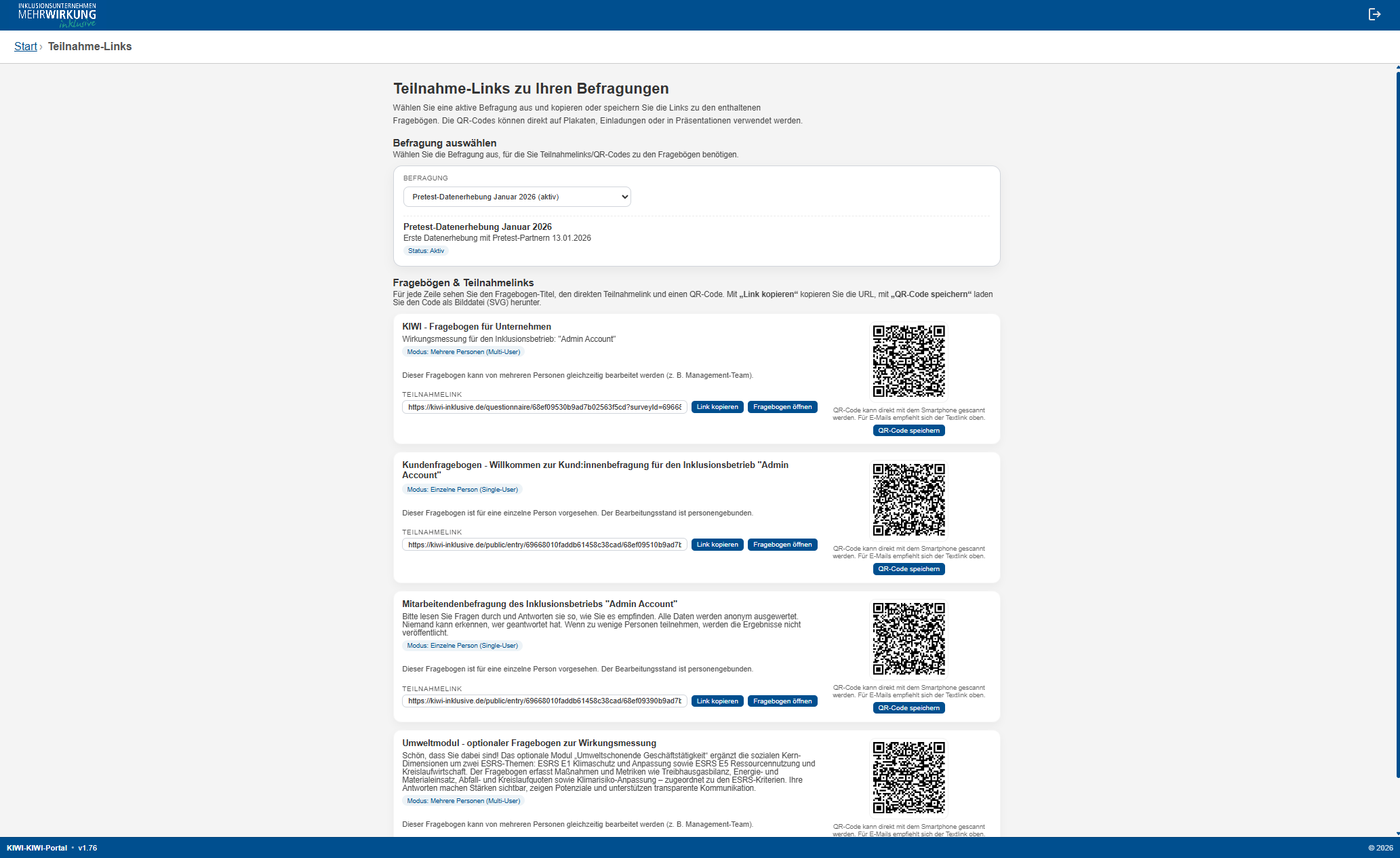
The system supports the creation and execution of configurable questionnaires and surveys targeting multiple stakeholder perspectives, including employees, customers, clients, and organizational representatives. Data collection modules can be adapted in content, language, accessibility level, and deployment mode, enabling both one-time assessments and longitudinal monitoring.
Collected data is processed through a modular analysis pipeline that maps responses and organizational indicators to predefined impact dimensions aligned with sustainability and inclusion frameworks. Evaluation logic, indicators, and weighting schemes are configurable, allowing the system to be tailored to different organizational sizes, sectors, or evaluation goals. Results are rendered through a dashboard-based “impact compass” that provides structured summaries, comparisons, and benchmarks.
Automated report generation is implemented through a modular AI architecture. A rule-based expert system ensures transparency and interpretability by structuring core findings and validating logical consistency. Optional large language model components refine the reports into readable, audience-specific narratives, without introducing or requiring personal data. Each reporting module operates independently while remaining connected through a shared data and rules model.
The interface prioritizes clarity, low interaction effort, and accessibility, supporting inclusive participation of employees with and without disabilities. The architecture follows a component-based design, allowing survey modules, evaluation logic, visualizations, and reporting components to be extended, replaced, or reused in other social impact contexts.
The platform is developed in close collaboration with inclusion enterprises and accessibility experts. All data is processed in aggregated form, without storing individual-level personal records. The system supports GDPR-compliant deployment, role-based access, and secure hosting. KIWI is currently in development and pretesting, with a pilot phase involving a larger network of organizations in preparation. Planned evaluations include usability, accessibility, interpretability of results, and organizational usefulness for decision-making and communication.
Core Features
Modular construction of questionnaires and surveys for multiple stakeholder groups
Flexible execution of impact assessments and longitudinal monitoring
Configurable indicators, evaluation logic, and benchmarking mechanisms
Dashboard-based impact visualization (“impact compass”)
Modular AI-supported report generation combining rule-based and generative components
Strong focus on accessibility, inclusive participation, and low interaction barriers
GDPR-compliant architecture with aggregated, non-personal data processing
Research Focus
Modular system design for social impact measurement
Human-centered and accessible interaction design
Explainable AI for automated reporting
Visual analytics for organizational decision support
Transferable architectures for social and sustainability-oriented applications

Our cooperation partner

KIWI is funded by the Aktion Mensch Stiftung.