ResourcifAI: AI-Powered Decision Support for Sustainable Environmental Resource Management
Project Description
ResourcifAI addresses the growing need for transparent, data-driven decision support systems in the context of sustainable development and environmental resource management. Climate change and environmental degradation are increasing the pressure on decision-makers to analyse large and heterogeneous data sources and derive reliable indicators of risks, impacts, and possible courses of action.
Transformer-based models offer great potential for analysing complex environmental data. In practice, however, their results often remain difficult to understand and can only be controlled to a limited extent. Existing approaches currently offer few user-centred and interactive ways to explore analysis results, understand their meaning, and actively intervene in the analysis process.
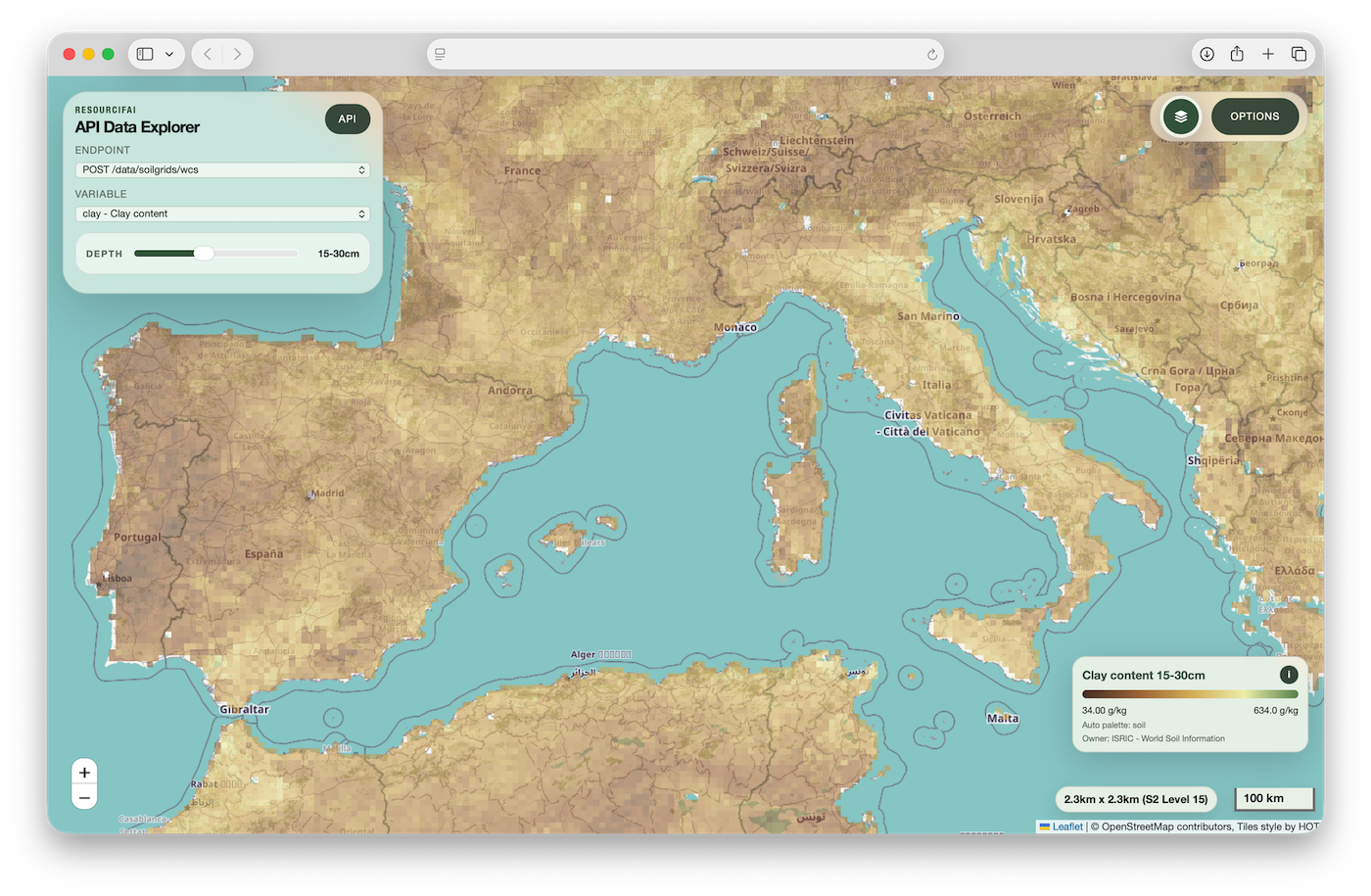
ResourcifAI therefore develops a Visual Analytics-based decision support system that directly couples transformer-based models with interactive visualisations. Users can explore extracted environmental indicators, specifically influence the underlying model behaviour, and immediately understand the effects of their interactions within the visual interface. Adjustments to inputs, parameters, or analytical focus support an iterative analysis and knowledge-generation process, increase transparency, and strengthen trust in AI-supported analyses.
The project pursues three closely interlinked research directions:
Optimisation of transformer-based models for extracting robust and context-sensitive environmental indicators from heterogeneous resource data.
Design of an interactive Visual Analytics approach that enables user-driven, real-time control and interpretation of model behaviour.
Extension of the system for comparative analysis in order to evaluate alternative courses of action and scenarios, including their potential impacts, uncertainties, and trade-offs.
The aim is to effectively support well-founded and sustainable decision-making processes in complex and uncertain environmental contexts.
Key Features
Transformer-based extraction of environmental and sustainability indicators from heterogeneous resource data
Interactive Visual Analytics interface with bidirectional coupling between the analytical model and the visualisation
Real-time visual control of model behaviour, such as analytical focus, parameters, and inputs
Visual exploration of impacts, uncertainties, and multidimensional indicator spaces
Comparative analysis of alternative courses of action and scenarios to support decision-making under uncertainty
Iterative, evaluation-based prototyping complemented by empirical user studies focusing on usability, transparency, and decision support