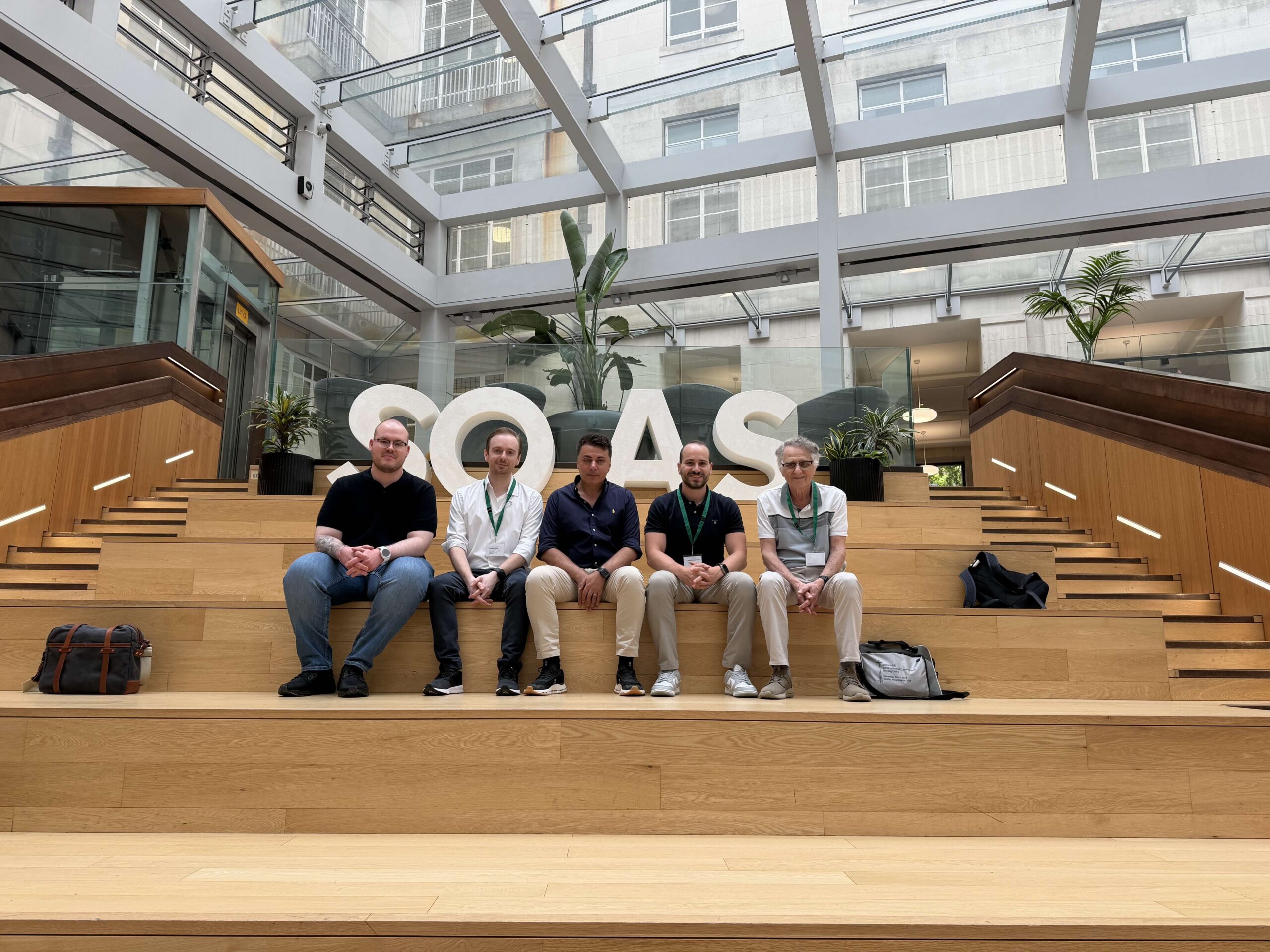
From 28 to 31 July 2026, our Human-Computer Interaction and Visual Analytics group participated in the 30th International Conference on Information Visualisation at SOAS University of London.
With six accepted papers, the conference provided an important opportunity to present our current research to the international Visualisation and Visual Analytics community. The papers will soon be published as part of the IEEE Conference Proceedings.
The contributions address applications in agricultural water management, collaborative research, healthcare, inclusion enterprises, policy modelling, and cross-phase research support.
A common focus across the papers is the combination of artificial intelligence and Visual Analytics. While AI and Large Language Models support the processing, retrieval, and transformation of complex information, interactive visual interfaces enable users to explore results, understand their context, and remain actively involved in the analytical process.
The six forthcoming publications are:
“Stakeholder-Oriented Visual Analytics for Agricultural Water Management under Climate Change Scenarios”
“Project-Centered Human-AI Orchestration in Collaborative Research Workspaces”
“Evidence-Grounded Medical Visual Analytics with Large Language Models for Patient Record Exploration”
“A Visual Analytics Framework for Impact Measurement in Inclusion Enterprises”
“A Knowledge-Grounded Visual Analytics Framework for Policy Modelling with Large Language Models”
“Persistent Research Artifacts in Visual Workspaces for Cross-Phase Research Support”
A particular highlight was the Best Paper Award for “Project-Centered Human-AI Orchestration in Collaborative Research Workspaces” by Midhad Blazevic, Jacob G. Benz, Jan Safferling, and Kawa Nazemi.
The paper presents a project-centered model for coordinating AI-supported research activities across ideation, literature screening, and academic writing while keeping the assistance transparent, contextual, and controllable.
Kawa Nazemi also participated in the panel session “Visualisation, Visual Analytics, and Visual Knowledge Discovery in the Age of LLMs.”
The panel brought together different perspectives on the changing relationship between Large Language Models, interactive visual systems, and visual knowledge discovery. It resulted in engaging discussions and valuable insights into the opportunities and challenges of combining generative AI with human-centered analytical environments.
IV 2026 offered an excellent setting to share our research, receive feedback, and exchange ideas with the international community. The six forthcoming IEEE publications, the Best Paper Award, and the contribution to the panel session reflect the breadth of our current work and our continued focus on transparent, interactive, and human-centered approaches to artificial intelligence and Visual Analytics.